Blog
Designing for Privacy in a Hyper-Connected World
08 April 2026
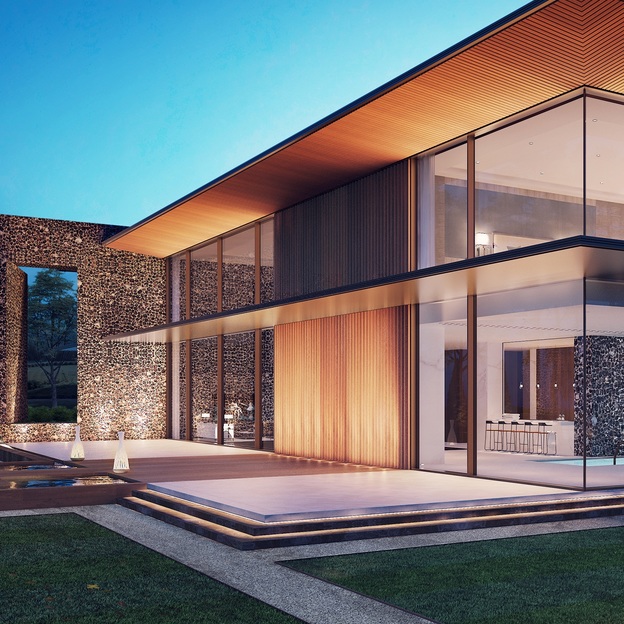
Privacy has become one of the most valued aspects of modern living—something clients now prioritise in a way that simply wasn’t the case a decade ago.
In a world where access is constant, the ability to step away—to feel contained, undisturbed, and in control of one’s surroundings—has taken on a different meaning. For many of our clients, whether commissioning a yacht or a private residence, that sense of withdrawal is no longer a secondary consideration. It is often the starting point.
Different Contexts, Shared Principles
While superyachts and private homes exist in very different settings, the underlying intent is remarkably similar.
Both are highly personal environments, shaped not only by aesthetics, but by how they are experienced over time. How one moves through a space, where one pauses, and where one can retreat without interruption.
On a yacht, this presents a particularly nuanced challenge. The very quality that defines life at sea—its openness—is also what requires careful calibration. Expansive views, light, and exposure must be balanced with moments of enclosure and calm.
In recent years, this balance has become more pronounced. Yachts have increasingly been used as places of complete removal, where privacy is not simply desirable, but essential. Designing for that requires a more layered, considered approach.
In residential projects, the parameters shift, but the objective remains consistent. Here, privacy is often shaped through architecture and landscape, through thresholds and boundaries. Yet the expectation is the same: a sense of ease, discretion, and quiet control.
A Layered Approach to Privacy
Rather than being defined by a single gesture, privacy is something that is built gradually.
We think carefully about arrival and sequence—what is revealed, what is held back, and how spaces relate to one another. The transition from more public areas to private ones should feel intuitive, never forced.
On board, this often comes down to the relationship between exterior and interior spaces, and the placement of cabins so they remain entirely secluded when required. On land, it is more often about planning and flow—ensuring that even within open, contemporary layouts, there is a clear sense of hierarchy and retreat.
One notable yacht has brought all the external spaces inward, creating something similiar to a private courtyard at sea. It allows for light and openness, but removes any sense of exposure. Completely unique in yachting and bespoke to the client’s required level of privacy.
Material and Atmosphere Privacy is not only spatial; it is also experiential.
Material choices play a subtle but important role in shaping this. In one residential project, we explored a timber wall construction that naturally limited signal transmission between spaces. It introduced a quieter, more controlled environment—not just acoustically, but digitally as well.
This reflects a broader shift in how privacy is perceived. It is no longer defined purely by what is visible, but by the level of control one has over the wider environment.
Discretion, Seamlessly Integrated
There is also an increasingly technical dimension to consider, particularly within yacht design. AV systems, communications, and data security have become more sophisticated, and in many cases, more critical. Clients are often managing sensitive information or require a high degree of discretion while travelling.
Our role is to ensure that these systems are fully integrated, without ever becoming apparent. The best solutions are those that remain invisible—supporting the experience without interrupting it.
Mobility as a Luxury
Yachts offer something that cannot be replicated on land: the ability to change one’s surroundings entirely.
Privacy, in this context, extends beyond the immediate environment. It becomes about movement—about choosing when and where to be, and having the freedom to remain unseen if desired.
For many, this is one of the most compelling aspects of life at sea.
A Quiet Balance
Designing for privacy is not about creating isolation. It is about balance. Spaces should feel open when they need to be and protected when they are not. They should allow for connection but never impose upon it.
After many years of practice, this is perhaps the most consistent thread in our work. When privacy is handled well, it is not something one actively notices. It simply underpins a sense of comfort and ease.