Blog
What Superyachts and High-End Residences reveal about how space should truly work.
05 May 2026
Designing Beyond Appearance
Designing a superyacht and shaping a penthouse in the Bahamas share more common ground than might be expected. Both operate at a level where nuance matters, and where decisions are not simply aesthetic, but behavioural.
At their core, both disciplines require an understanding of how people live and move, and how they instinctively respond to space, proportion, and sequence.
When we established the studio over twelve years ago, we saw little reason to separate these worlds. From the outset, we worked across both superyacht and high-end residential projects, allowing each to inform the other. It wasn’t a strategic position—simply a natural way of working. Over time, it has become fundamental to how we think.
Working across both disciplines sharpens your judgement. Certain assumptions fall away. You become more selective about what truly matters—and what is simply aesthetic. In our case, it led us to focus not only on how spaces present themselves, but fundamentally on how they perform in daily use, and how they support the rhythms of daily life.
There is often a tendency to view yachts and residential environments as inherently different. Yachts are governed by classification societies and technical constraints; residential projects by planning frameworks and building codes. One moves; the other remains still. Those distinctions are real—but they are not especially useful. The value lies in what carries across both.
On a superyacht, circulation is never incidental. It is resolved with precision. Corridor widths, thresholds, transitions between spaces—all are carefully considered for clarity and ease of movement as well as compliance. The vessel itself demands it. When done well, the result is something that feels effortless, even inevitable. You move through the space without hesitation.
This clarity is not about minimalism or restraint for its own sake. It is about performance. A well-designed yacht interior is orchestrated. Every element contributes to how the space is used, not just how it is seen. Good design, in this context, is rarely defined by photography. It is defined by how naturally the space works.
Over time, we came to realise that this same discipline—this focus on movement and spatial logic—has equal relevance on land.
Movement through the home felt disjointed. Circulation routes were unclear, with spaces that interrupted rather than supported one another. Rooms existed as individual moments, but without any connection. The result was a house that looked impressive but did not feel entirely comfortable to inhabit.
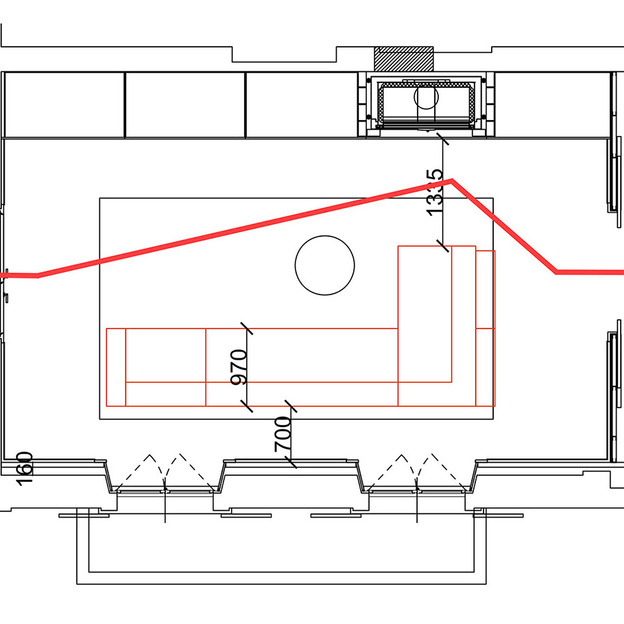
Our approach was to step back from the surface and aesthetics and reconsider the underlying structure of the plan. As we would on a yacht, we began with circulation—mapping how one moves through the space, how transitions occur, and how different areas relate to one another.
We adjusted alignments, redefined thresholds, and introduced a clearer hierarchy between public and private zones. Furniture layouts were reconsidered not as isolated elements, but as part of a wider spatial narrative. Sight lines were opened where appropriate, and gently controlled where privacy was required. Materials were used not only for their aesthetic qualities, but to subtly reinforce movement and direction.
None of these interventions were overt. In many cases, they were barely perceptible as individual changes. Yet collectively, they transformed the experience of the house.
The spaces began to flow. Movement felt intuitive. The house became easier to inhabit—not because it had changed dramatically in appearance but because it had been quietly resolved.
This is where the two disciplines converge.
Whether designing for sea or land, the success of a space is rarely determined by what is immediately visible. It lies in the underlying logic—in how well the space anticipates and supports the people who use it. When circulation is considered, when proportion is understood, and when movement is allowed to unfold naturally, the result is something that feels composed without effort.
After twenty-five years working across both worlds, this remains one of the more consistent lessons: when a space is properly resolved, very little needs to be said about it.